Dogs in Digital Illustration: A Practical Resource for Creative Professionals
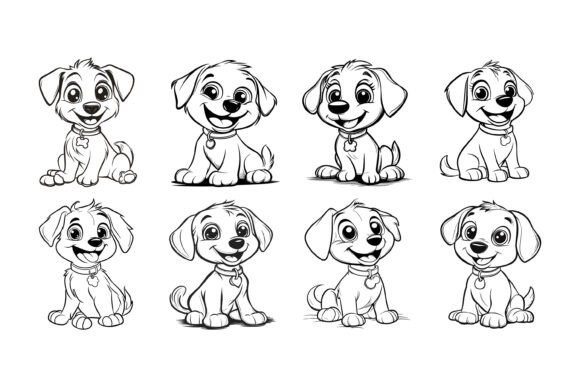
The depiction of animals, particularly dogs, in digital media requires a blend of aesthetic appeal, technical accuracy, and versatile application. For designers, marketers, and content creators, sourcing high-quality vector illustrations of dogs can be a time-consuming task, often involving compromises on style consistency or editability. A specialized collection of AI EPS files focused on dog illustrations addresses this need directly, serving as a foundational graphic asset for a wide range of projects.
Understanding the Value of a Dedicated Illustration Set
In professional design workflows, efficiency and reliability are paramount. A cohesive set of illustrations centered on a single theme—like dogs—provides a consistent visual language that can be deployed across multiple touchpoints. This goes beyond merely offering a few generic silhouettes. A comprehensive collection should encompass variety in breed, posture, and expression while maintaining a uniform artistic style. This consistency is crucial for brand projects, educational materials, or app development where visual coherence strengthens user recognition and communication.
The practical value lies in the reduction of preparatory work. Instead of sourcing, licensing, and adapting disparate images from multiple artists, a unified set allows a designer to begin with assets that are already technically compatible and stylistically aligned. This foundation enables the creative effort to be focused on application and customization, rather than on basic asset assembly and correction.
Key Characteristics and Technical Strengths
The core strength of a professional AI EPS collection for dogs is its technical construction and organization. Files designed for both Mac and Windows users eliminate a common cross-platform compatibility hurdle. A neat layer and file structure is not a minor convenience; it is a significant efficiency feature. When every element is logically grouped and named within the vector file, editing becomes a precise task. You can isolate a specific part of an illustration—a tail, an ear, the outline—without struggling with merged paths or hidden layers, saving considerable time during the modification process.
Perfection in details and consistency refers to the artistic execution. Line weights, curvature, and proportional scaling should be handled with care across all illustrations, ensuring that a small terrier and a large retriever feel like part of the same family of artwork even at different sizes. This meticulous attention guarantees that the illustrations remain effective when scaled for a large print poster or reduced for a mobile app icon, without losing definition or becoming visually disjointed.
Flexibility in Application and Modification
The true test of a vector asset's quality is its adaptability. The ability to easily edit, change colors, and modify icons according to specific needs transforms a static image into a dynamic design component. For example, a marketer might need to adjust the color of a dog illustration to match a brand's palette for a campaign mascot. An app developer might require a simplified, outline-only version of the same vector for a UI button. A strong EPS collection supports these transformations without requiring extensive redrawing or expert-level Illustrator skills.
This flexibility directly influences the set's suitability for diverse mediums: print, web, symbols, apps, and infographics. A single, well-crafted vector source can output to high-resolution CMYK for a brochure, be optimized as an SVG for a website, and be styled as a flat icon for an infographic. This multiplies the return on the initial asset acquisition, offering long-term value as project requirements evolve.
Who Benefits Most from This Resource?
This type of specialized illustration set is particularly advantageous for professionals and creators who regularly produce content within a thematic niche or who require recurring visual motifs.
- Freelance Designers and Small Agencies: Those working with pet-related brands, veterinary clinics, animal shelters, or pet service businesses can leverage a ready-made, professional set to accelerate project timelines and maintain a high standard of visual output.
- Content Marketers and Bloggers: Individuals producing articles, guides, or social media content about dogs, pet care, or animal welfare can use these illustrations to enhance their material with consistent, royalty-free graphics that are more engaging than generic stock photos.
- Educators and Publishers: Creating worksheets, children's books, or informational pamphlets on animals requires clear, appealing imagery. A customizable set allows for tailoring illustrations to specific educational contexts.
- App and Game Developers (Indie/Small Teams): For projects involving pets or animals, having a set of editable vectors for characters, icons, or UI elements can streamline the asset creation phase of development.
Practical Considerations and Workflow Integration
Integrating such a collection into a real-world workflow is straightforward. The included JPG files serve as quick previews or placeholders for low-stakes mockups, while the AI EPS files form the core editable resource. The organized structure means you can quickly browse and select the specific dog illustration needed without opening multiple master files.
A potential limitation to consider is stylistic match. While the set promises consistency within itself, its pre-defined artistic style must align with the existing visual direction of your project. It is advisable to review the aesthetic—whether it's lifelike, cartoonish, minimalist, or detailed—to ensure it complements your work. Furthermore, while editability is a key feature, complex modifications beyond color changes or simple rearrangements may still require proficient skills in Adobe Illustrator or similar vector software.
Evaluating Long-Term Value
The long-term value of a dog-focused AI EPS collection is measured in its reusability and scope. A robust set covering various breeds, actions (sitting, running, playing), and perhaps even thematic elements (dog accessories, environments) can serve a creator for multiple projects over years, avoiding the need to repurchase assets for each new task. Its value compounds for users whose work consistently touches the theme of dogs.
For the generalist designer or hobbyist who only occasionally needs dog illustrations, the value proposition is different. It may be more practical to source individual vectors on an as-needed basis. However, for the professional whose audience, niche, or client base is closely linked to this subject matter, the investment in a comprehensive, high-quality, and organized collection can significantly optimize creative production and ensure a reliable standard of visual quality.
Ultimately, the utility of these illustrations is defined by their precision, ease of use, and adaptability. They are a tool, not a finished product. Their worth is realized through the professional's ability to integrate and customize them effectively to meet specific communicative goals, saving time while maintaining control over the final design outcome.