Japanese Food Outline Icons: A Designer's Toolkit
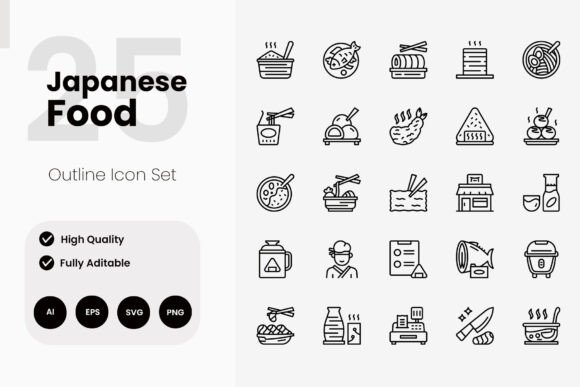
When we think of Japanese cuisine, vivid images come to mind: the delicate arrangement of sushi, the comforting steam from a bowl of ramen, the precise art of the bento box. Capturing these iconic symbols in a clean, versatile design style opens a world of practical application for creators. Japanese Food Outline Icons are not just simple drawings; they are a functional asset collection designed for clarity and adaptation.
This specific set, available in formats like AI source files, EPS, SVG, and PNG with transparency, is engineered for professional and personal projects. The outline style strips away color and shading, focusing on form and recognizability. This makes the icons exceptionally adaptable, serving as neutral elements that can be colored, scaled, and integrated into vastly different visual contexts without losing their essential character.
Why a Simple Style Matters to Different People
The value of a well-crafted icon set is not universal. It shifts dramatically depending on who you are and what you aim to create. A marketer might see a tool for swift, consistent branding, while an educator might view them as clear visual aids for a lesson on global cultures. The outline approach, in particular, speaks to priorities of flexibility, ease of use, and professional presentation.
For Creators and Design Professionals
If you regularly work in Adobe Illustrator or Photoshop, the provided AI source file is a significant advantage. It means you can deconstruct the icons, edit paths, combine elements, or extract individual components without starting from scratch. The vector formats (EPS, SVG) ensure that whether you're designing a massive poster or a tiny app button, the image quality remains sharp. A freelance designer tasked with creating a menu for a new izakaya (Japanese pub) could use these icons as a foundational layer, quickly customizing their color to match the restaurant's brand palette, saving hours of illustration time.
Their evaluation focuses on technical quality: are the vector paths clean? Is the iconography accurate? Does the set include a comprehensive range of items—from common dishes like tempura and onigiri to utensils like chopsticks and sake bottles? The long-term usefulness lies in having a reliable, scalable resource for multiple client projects.
For Entrepreneurs and Small Business Owners
Running a food blog, a small catering service, or an online shop selling Japanese ingredients presents unique communication challenges. Visuals can bridge language gaps and instantly convey theme. These outline icons can be employed on a website to visually categorize blog posts, in social media posts to highlight daily specials, or on printed flyers to give a clean, modern look. The PNG files with transparency allow easy drag-and-drop use in tools like Canva or basic word processors, which might be the primary software for a busy owner.
Here, priorities like speed and cost-effectiveness come forward. Purchasing a ready-made, multi-format set avoids the expense of hiring a custom illustrator. The key question is whether the icons' style aligns with the business's existing visual identity—their simplicity can be a boon for a minimalist brand but might feel too stark for a more ornate one.
Practical Applications Beyond Commercial Use
The utility of these icons extends far into educational and personal projects. Their clarity makes them excellent for learning materials.
Educators and Hobbyists
A teacher creating a unit on Japanese culture can use these icons in worksheets, presentations, or classroom decorations. The outline style is perfect for coloring activities where students can engage with the imagery directly. A hobbyist learning Japanese language might use them to create flash cards, associating the icon with the word for the food item. For these audiences, the learning value and ease of integration into common software (using the PNGs in PowerPoint or Google Slides) are the main attractions. They are less concerned with commercial licenses and more with accessibility and thematic coverage.
Bloggers and Content Publishers
Whether writing about travel, food reviews, or recipe development, bloggers need to break up text and guide readers visually. Japanese Food Outline Icons can serve as consistent thematic markers within articles. For instance, using a small sushi icon whenever discussing sushi restaurants, or a ramen bowl icon to head a recipe section. This creates a subtle, professional visual language across the blog. The SVG format is particularly useful here, as it can be optimized for web speed without losing quality, a crucial factor for site performance and user experience.
Different users will weigh the formats differently. A mobile app developer might prioritize the SVG files for their scalability and small file size in an interface. Someone focusing on print materials, like flyers or banners, might rely more on the high-resolution EPS or PNG files. This is why a multi-format bundle provides its core benefit: it lets you choose the right tool for your specific medium.
Aligning the Set with Your Project Goals
Before deciding if this collection is right for you, consider your primary needs. Are you looking for creative flexibility to modify and adapt? The source vector files are essential. Is immediate, easy use your driver? The ready-to-use PNGs will serve you best. For projects intended for broad public consumption, like a textbook or a national restaurant chain's marketing, verifying the commercial license terms is a necessary step.
Ultimately, Japanese Food Outline Icons are a pragmatic solution. They don't shout with color or intricate detail; they provide a clear, modular visual vocabulary. For anyone needing to communicate concepts around Japanese food efficiently and with aesthetic consistency—from the professional designer refining a brand to the hobbyist crafting a personal project—this toolkit removes the barrier of creating those foundational visuals from scratch. It allows you to focus on your larger creative or communicative goal, with the icons serving as reliable, adaptable components in your work.