The Eggs Illustration Suite: A Tool for Consistent Visual Communication
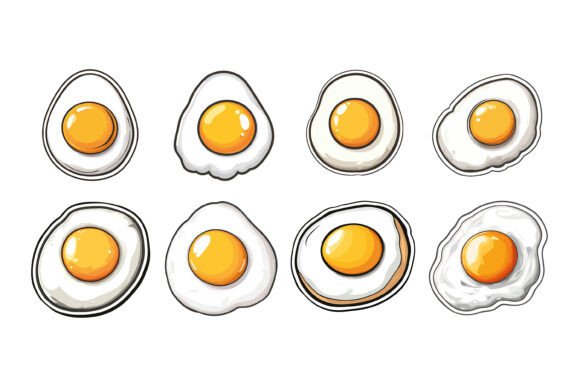
In professional design and content creation, visual consistency is not just an aesthetic preference; it is a functional necessity. A coherent set of icons, symbols, and illustrations establishes brand recognition, enhances user comprehension, and streamlines production across multiple platforms. Eggs, a specialized AI EPS illustration collection, addresses this need directly. It is not merely a bundle of graphics but a systematized asset library designed for integration into a real workflow.
A Foundation of Technical Integrity
The core value of Eggs lies in its technical construction. Provided in both AI and EPS vector formats alongside JPG previews, the files are fundamentally editable. This is crucial. Many "premium" illustration sets are delivered as flat, rasterized images or locked PDFs, offering no flexibility. Eggs, by contrast, is built from the ground up as a modifiable resource. The vector format ensures that every line, shape, and color is defined by mathematical paths, allowing for infinite scaling without loss of quality—a basic requirement for any asset used across print, web, and application interfaces.
Furthermore, the claim of a neat file and layer structure is a significant practical point. In a complex Adobe Illustrator document, a disorganized layer stack with unnamed paths and grouped elements can turn simple editing into a time-consuming puzzle. A well-structured file, where layers are logically grouped and labeled, reduces friction. It allows a user, whether on Mac or Windows, to quickly isolate a specific icon element, change its color, or adjust a detail without deconstructing the entire artwork.
Evaluating Perfection in Details and Consistency
The phrase "perfection in details and consistency" speaks to a qualitative benchmark. In practical evaluation, this translates to a uniform visual style across the entire collection. The line weights should be consistent, the stylistic approach—be it minimalist, geometric, or hand-drawn—should be cohesive, and the color palette, if one is included, should be harmonized. This consistency is what makes a collection like Eggs a true "suite" rather than an assortment of individual pieces. For a marketer creating an infographic, a developer needing app symbols, or an educator designing instructional materials, this uniformity means that pulling different icons from the set will result in a final product that looks professionally assembled, not haphazardly cobbled together.
The Practical Spectrum of Application
Eggs is explicitly noted as suitable for print, web, symbols, apps, and infographics. This breadth of application underscores its intended versatility. For print, the vector integrity guarantees high-resolution output. For web and apps, the assets can be exported at precise sizes and in optimal formats. The mention of "symbols" points to its utility in UI/UX design, where clear, recognizable icons are required for navigation and functionality.
The real-world performance hinges on how seamlessly these assets integrate. A designer working on a brand identity extension can use Eggs to quickly generate supplementary imagery that aligns with existing materials, modifying colors to match the brand palette. A freelance blogger can elevate their content with custom diagrams without commissioning an illustrator. The ease of modification is the key variable here. The promise that you can "edit it, change colors and modify the icon so easily" directly impacts its long-term value. An asset that can be adapted to future projects or changing brand guidelines offers a return on investment that a static image pack does not.
Audience Fit and Professional Observations
Who benefits most from a resource like Eggs? The audience is broad but defined by a common need: efficient, high-quality visual production without starting from a blank canvas every time.
- Entrepreneurs and Small Business Owners: Those managing their own branding and marketing materials can use Eggs to create a consistent visual language across their website, presentations, and printed goods, ensuring a professional appearance without the cost of custom design for every element.
- Marketers and Content Creators: Individuals tasked with producing regular infographics, social media content, or campaign assets will find a pre-built, editable library drastically reduces production time while maintaining quality.
- Freelancers and Designers: Professionals across disciplines can leverage Eggs as a base component in client work. It serves as a reliable starting point, allowing them to focus their time and creativity on the unique aspects of a project rather than on reinventing common visual elements.
- Educators and Publishers: Creating clear instructional diagrams, textbook illustrations, or online course materials requires accurate, scalable graphics. A well-organized vector set is a practical solution.
Considerations and Balanced Assessment
While the strengths are clear, a balanced evaluation requires noting where Eggs might not fit. Its value is proportional to the user's need for a cohesive *set* and their comfort with vector editing software like Adobe Illustrator. A hobbyist or blogger with no access to or knowledge of Illustrator would not be able to utilize the primary AI/EPS files, relying instead on the JPGs, which sacrifice scalability and editability. For them, the value diminishes.
Furthermore, the term "AI EPS" likely indicates the files were created or assisted by artificial intelligence tools. This can be a positive, suggesting a vast range of icons generated efficiently, but the ultimate test is in the human curation and organization. An AI can generate thousands of icons; a useful collection requires thoughtful selection, style unification, and logical structuring. The quality of Eggs, therefore, depends less on the tool of origin and more on the rigor of its final compilation and file preparation.
Integrating Eggs into a Professional Workflow
For a potential user, the decision hinges on workflow compatibility. If your projects routinely require custom icons, interface symbols, or explanatory illustrations, and you already operate within a vector-based design environment, Eggs presents a logical asset acquisition. It is a capital investment in your production toolkit. Before commitment, however, a professional would seek to verify the specifics: the exact scope of the icon library, the true organization of the layers, and the stylistic range to ensure it aligns with the visual tone required for their audience or brand.
In conclusion, the Eggs illustration collection positions itself as a specialized tool for visual communication. Its stated strengths—technical format, organization, consistency, and editability—address genuine pain points in content and design production. Its effectiveness is not in being the only solution, but in being a well-executed one that respects the user's need for control, adaptation, and professional results. For the right user in the right context, it can function not as a disposable graphic pack, but as a persistent, adaptable resource within their creative process.